


OPEN ACCESS
Reporting OA Usage: A Global Question
COUNTER is valuable in assessing OA usage! There is a real need to understand how the transition to OA is working, what makes it work and what is the impact of OA. All these require measurement and reporting, and COUNTER offers a consistent, credible, comparable method for doing so.
We’re launching a new working group on OA reporting in April 2026, so watch this space!

Introduction: Why Use COUNTER For OA?
COUNTER is a community collaboration between libraries, consortia, publishers, aggregators and technology providres who want a shared standard for usage. The Code means we can all measure usage of online scholarly content in a consistent, credible, comparable way. Our metrics are the same, no matter how content has been licensed (e.g. copyright or Creative Commons), who funded the research, or who paid for publication. One of the claims about OA is that it drives increased usage. Without using the same metrics, measured in the same way, it’s very difficult to justify that claim. That’s why we built R5.1: if you are using normalised COUNTER metrics to measure both OA and subscription usage, you can be sure you’re comparing like with like.
Download Translations
Translations of the Friendly Guide are available in five languages, thanks to the generosity of members of the COUNTER community who provided funds and time to help us produce them.
- SpringerNature funded our Chinese translations
- Thieme sponsored German translations
- Gale covered the costs of our Spanish translations
- Thanks to the Couperin Consortium and the Canadian Research Knowledge Network for French translations
- And to Yuimi Hlasten at Denison College for Japanese translations
The Details
Access Type: Open
As we say in the Tech Guide, the Access Types element helps to split out subscription materials from those that are open access or free to read. For OA content, you’ll want to look at usage metrics for Access Type: Open.
COUNTER volunteers have been discussing and debating the definitions of COUNTER Access_Types since we started work on R5 in 2015. There is no solution that will work for everyone, so we aim for a compromise. In R5.1, we’ve set out to offer a neutral definition of Open. That’s because the OA community, and the scholarly communication community more broadly, has yet to reach agreement on what the different types of OA actually are. We think there are at least four factors in play:
- Licence type isn’t as simple as it looks on the surface. Is only CC BY acceptable? If so, which version of CC BY? We’re up to CC BY 4.0 and there’s every likelihood future iterations will come into play. And why not CC BY NC ND?
- Timing. Is it only OA if it’s open from the day of publication? If so, what about repository copies that are opened after an embargo?
- Title-level operational model (hybrid vs OA-only) is reasonably straightforward. We’ve got that covered: if both Controlled and Open Access_Types show up in reports, you’ve got a hybrid journal.
- And that’s before we get to questions of the business model. Tasha’s article from 2024 identified more than 30 different OA business models in nine broad categories.
Return On Investment
People tend to think about COUNTER reports as one of the inputs information librarians use to evaluate subscription content, but COUNTER metrics do have a role to play in evaluating the investment libraries are making in OA.
Cost Per Download
One of the ways libraries have traditionally relied on COUNTER usage reports was as a basis for calculating cost per download, or cost per use. We know that an increasingly large volume of scholarly output is OA (just check out the OASPA data from Jan 2026!). Because of that increase, libraries and funders want to know the equivalent cost per use calculation for OA content.
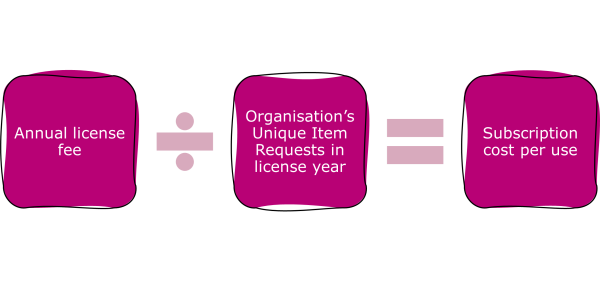
The typical cost per use calculation for a subscription journal is…
By contrast, here’s the cost per use calculation for an OA article…
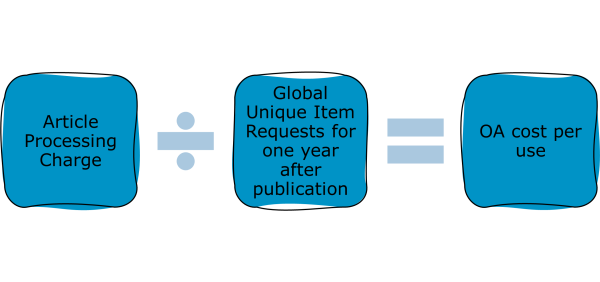
There is a caveat for the OA calculation! If you look only at the first year of usage, you aren’t going to be able to see the long-term value of investments in OA.
The key difference between the subscription and OA calculations is whether the Unique Item Request metrics are for a particular institution or for the whole world. Subscription cost per use looks only at the usage within a particular organisation. Paying for content to be OA is an investment in perpetual openness, so OA cost per use looks at global usage. The next section, Reporting to The World, explains the difference.
Impact
We think that usage data should be one of the ways we measure impact. At the moment, citations and altmetrics are often used as proxies for impact:
- Citations are very direct. A citation means the work has been found and (hopefully) read and found useful by a scholar. They are, however, quite laggy and in some fields take decades to accrue.
- Altmetrics typically assess social media and other online activity associated with a piece of scholarship, so while they are more immediate than citations, altmetrics are often reflective of fleeting attention rather than lasting impact on scholarly practice or the wider world.
Comparable, consistent usage metrics of the kind produced by COUNTER-compliant platforms are a third type of impact measure. Unlike citations usage accrues from the day of publication, and unlike altmetrics we can be sure that usage reflects some form of engagement with the original content.
While we think usage, citations and altmetrics are useful, we want to be clear that research assessment should be a holistic exercise. None of these metrics should be used alone, and none should be used without an appreciation of the scholarly merits of the work!
Reporting To The World
Most publishers tell us that a proportion of their usage can’t be linked to an institution, so R5.1 includes instructions to attribute that usage to ‘The World’. By adding together all of the institution-linked (attributed) usage with The World usage, publishers can create a global COUNTER report.
Linking Usage To Institutions
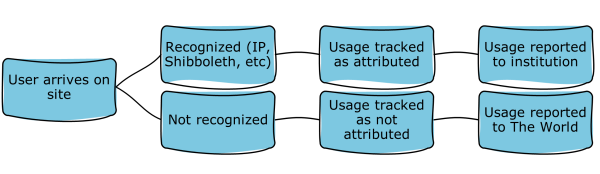
Users’ activity (usage) is linked to institutions through the processes of authentication and attribution. When a user visits a publisher platform, the first thing the platform will do, usually invisibly, is check to see whether the user can be authenticated. Recognizing IP ranges is a common method of authentication. There are many others, including Shibboleth, username/password, and GETFTR.
Users who can be authenticated as belonging to an institution are easy: we tell publishers to attribute and report all of their usage to that institution. Users who can’t be authenticated as belonging to an institution may still be able to read content, particularly where it’s OA. The publisher needs to track that usage, but it belongs to ‘The World’.
Building Global Reports
Global usage of publisher platforms is built up of non-attributed and attributed usage. That is, the combination of usage linked to institutions and usage that is more generally linked to ‘The World’. Most publishers track all usage by default, and produce COUNTER Reports by extracting attributed usage per institution, so they have the information they need to produce a global report.
Global reports can be broken down while maintaining user privacy and protecting commercial confidentiality using Reserved Elements. We recommend breaking global reports down geographically by country or country subdivision (e.g. state), and of course by attributed versus non-attributed. There’s a little more information about that in The Friendly Guide to COUNTER Attributes, Elements, and Other (Slightly) Techy Things.
Global Item Reports: The Key To OA Reporting
We think global reporting is essential for understanding OA, so we allow all four COUNTER Reports (the Platform, Database, Title and Item Reports) to be offered as global reports. We think the Global Title Report could be really useful for OA-only journals, particularly ones using cooperative models like Subscribe to Open.
Transactional OA models, like article processing charges, have made it important to understand usage more granularly. Libraries who have paid for a specific journal article or book chapter to be made OA want to know the global usage of that specific piece of content. In R5.1 we recommend that all report providers, but particularly journal and book publishers with OA offerings, should provide Global Item Reports. That is, we’re asking for an Item Report (IR) to The World. As you’ll know if you’ve read the Friendly Guide to COUNTER Reports, IR is very granular and shows every applicable COUNTER metric for every single item on a platform, with a lot of information about the item itself (e.g. identifier, parent title if any).
Read more about global reports and grab some sample files on our blog.