
Introducing TRACE
06 October 2026Tasha’s taking part in a panel at the STM Frankfurt event today, about a new initiative called TRACE.
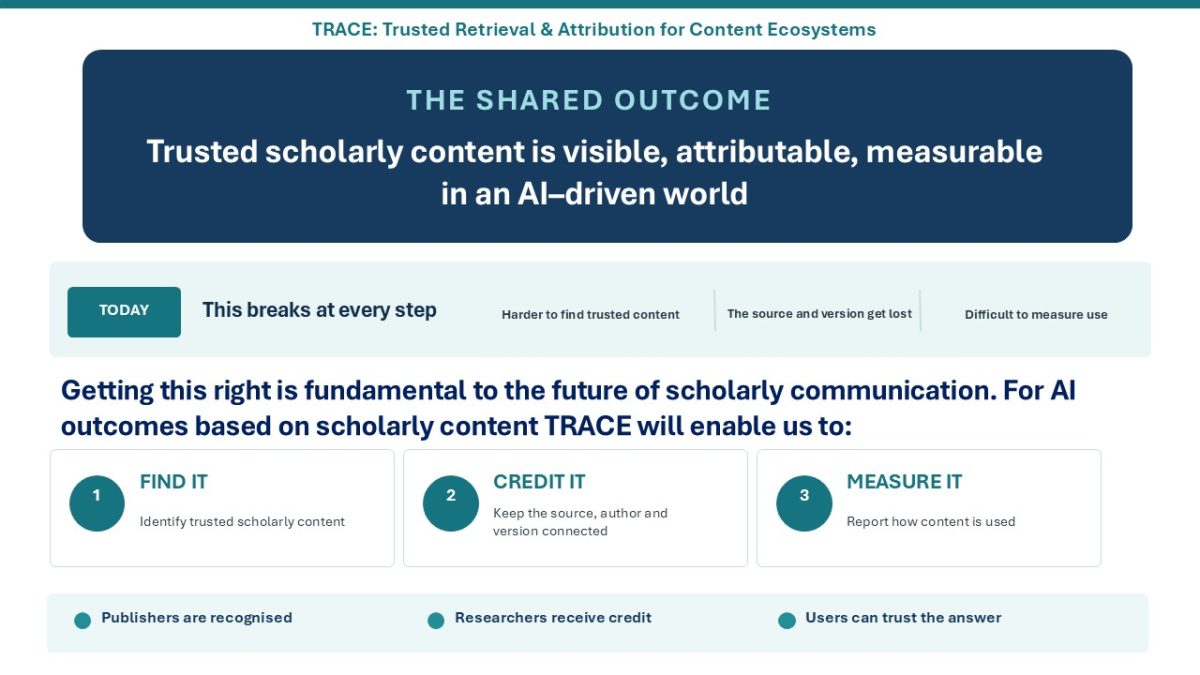
Scholarly content is the accumulated, peer-reviewed, version-controlled record of human knowledge, with provenance that matters for human progress. It isn’t controversial to say that as scholars increasingly interact with knowledge through AI assistants and agents, AI systems need to be able to
- Identify authoritative scholarly content;
- Distinguish it from less reliable sources;
- Preserve provenance;
- Provide transparent attribution.
TRACE brings together publishers, standards organisations (that’s us and NISO), and other participants across scholarly communications to build the infrastructure that makes this possible.
COUNTER and TRACE
We started working on AI usage metrics in 2025, a year before the TRACE project was conceived. Our working group included representatives from TRACE publishers, as well as other publishers, technology providers, and libraries, from day one. By engaging with TRACE we’re able to keep the senior leadership at the participating companies aware of what we’re doing. They’re also giving us some funding, which will mean we can develop the COUNTER API and JSON Schema to properly include the new AI metrics that we’ve been working on.
That means you’ll see this label on our AI best practice when it is updated with the phase two information:
“Development of the COUNTER API and JSON Schema to accommodate AI usage metrics is part-funded by TRACE – a cross-stakeholder initiative involving STM, NISO, COUNTER, and other partners examining the future of trusted retrieval and attribution in AI-mediated scholarly communication, for the benefit of the entire scholarly communications ecosystem.”
TRACE in a nutshell
TRACE aims to lay the groundwork for scholarly content to reach AI systems with its provenance and attribution intact. The projects it funds or part-funds are gathering evidence on how AI agents access content today, developing a shared model for provenance metadata, and setting out guidance for reporting AI usage (that’s us again). It will mean publishers, platforms and AI developers can build on common ground rather than one organisation at a time. TRACE aims to ensure we have a system where authors are credited, libraries can see how the content they license is used, publishers are recognised for the value they create, technology companies can build more reliable AI products, and researchers can see where an answer came from.